


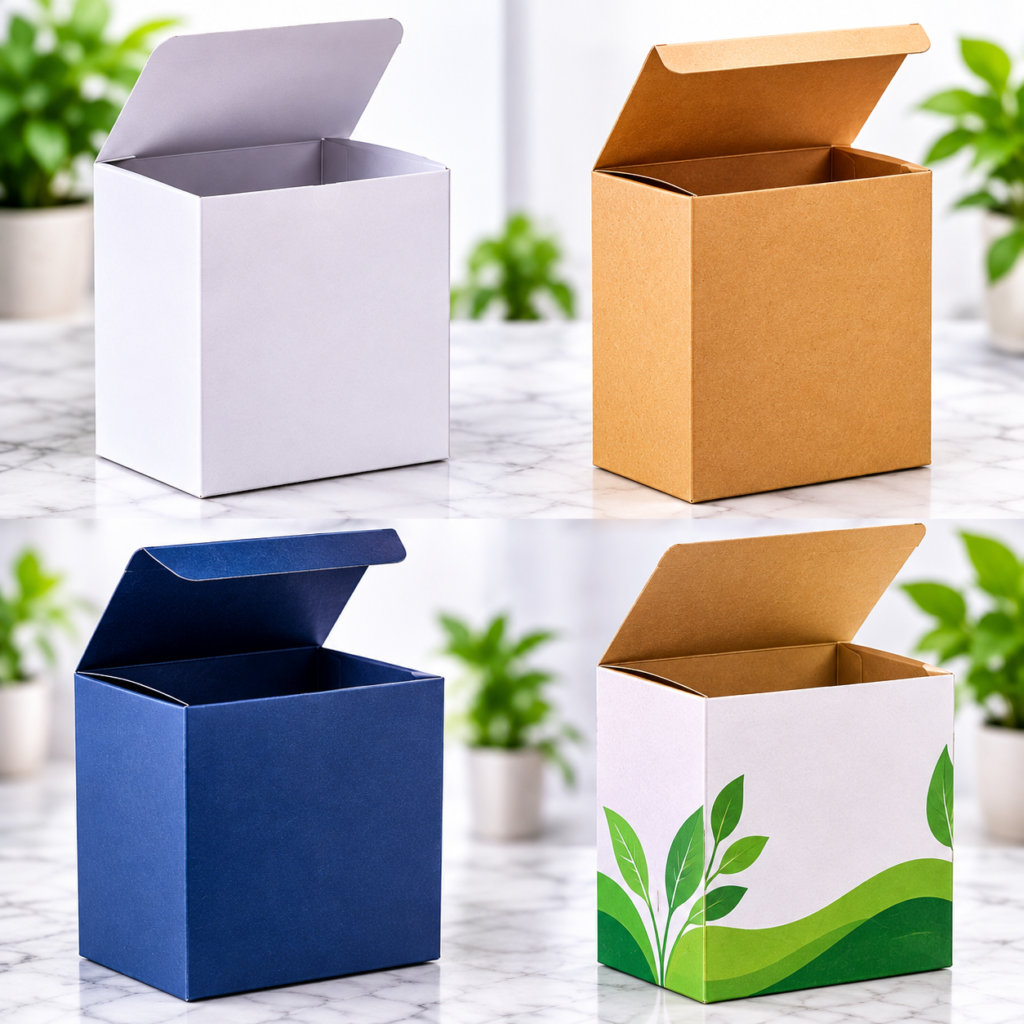
Ask for a tuck box and you will be offered at least four different constructions. They all close with a tuck flap, they all ship flat, and they can all carry the same printed design. Yet they behave very differently once a product goes inside. The right choice protects the product, packs fast and keeps the cost per box under control. The wrong choice sags, pops open, or quietly wastes board on every run.
This guide walks through the main tuck box styles one by one: straight tuck end, reverse tuck end, auto bottom and roll end. Each style gets a plain explanation, its real advantage, and the products it suits best. A comparison table and a 3-step checklist at the end turn those details into a decision you can make in minutes.
First, the Big Split: Folding Cartons vs Corrugated Mailers
Most confusion starts here, so it is worth clearing up first. Tuck boxes come from two different families, and they are built for two different jobs.
The first family is the folding carton. Straight tuck, reverse tuck and auto bottom boxes are normally cut from paperboard. It is the smooth board used for retail packaging. They are light, they print beautifully, and they are made to stand on a shelf. Think of them as the product’s retail outfit.
The second family is the corrugated mailer. Roll end styles are built with fluted board and double-thick side walls, because their job is travel, not display. They protect a product through sorting hubs, delivery vans and doorsteps.
The practical rule is simple. If the box sells the product on a shelf, it is probably a folding carton. If the box has to survive the mail on its own, it belongs to the mailer family. Mixing the two up is a common and expensive mistake. A good product arrives in a crushed box, or a shelf product ends up overpacked and overpriced.
Within the folding carton styles, a few structural terms are worth knowing. Dust flaps are the small side flaps that fold in first; they keep dust out and give the main tuck flap something to press against. The tuck flap itself stays shut through a friction lock, where the flap wedges snugly into the carton, or a slit lock, where a small tab catches in a slit. None of this is visible on the shelf, but it decides whether a box stays neatly closed or gaps open in a customer hand.
Straight Tuck End (STE): The Clean Retail Look
The straight tuck end is the display specialist of the family. Both flaps hinge on the same panel, so both ends tuck in the same direction. As a result, no flap edge or crease crosses the front of the box, and the artwork gets one clean, unbroken face.
That clean face is why premium brands default to this style. A window can sit anywhere on the front, and a design can run edge to edge. A full shelf row looks uniform too. Assembly is quick as well: the carton pops into shape and both ends close the same way, so there is nothing to learn.
Best for: cosmetics, perfumes, luxury skincare and gift products. If you sell 4 oz skincare jars on a retail shelf, this is your starting point. For a full breakdown of how it compares with its closest rival, read our guide to straight tuck end vs reverse tuck end boxes, or go straight to the product page for custom straight tuck end boxes.
Reverse Tuck End (RTE): The Budget-Friendly Workhorse
The reverse tuck end uses the same carton with one change: the flaps hinge on opposite panels, so the ends tuck in opposite directions. That small change pays off on the printing press. The flat blanks nest into each other head to toe, so less board is wasted and more boxes fit on every sheet.
At a few hundred boxes, that saving is minor. At tens of thousands, it lowers the cost of every single box. That is why this style is the cheapest of the family at volume. The trade-off is a crease line along the bottom edge of the front panel, so the face is slightly less clean than the straight tuck version.
Best for: lightweight products in large, repeat runs. Soap bars, teas, pharmaceuticals and small accessories are the classic examples. If you reorder the same soap carton every month, reverse tuck end boxes will usually give you the lowest cost per box in the family.
Tuck Top Auto Bottom: For Heavy Products and Fast Packing
The auto bottom changes the part of the box that does the hardest work: the base. Instead of a tuck flap, the bottom is pre-glued at the factory. When you pop the flat carton open, the base locks into place by itself, ready to fill. The top still closes with a normal tuck flap.
This is the real answer in the auto lock bottom vs tuck end box debate. A tuck flap base is held by friction, and friction has limits. A glued, interlocking base carries weight mechanically, so it does not sag or pop open under a heavy product. It also removes the slowest step in hand packing. Nobody has to fold and tuck a base before filling.
The unit cost is slightly higher, since the gluing happens at the factory. For heavy products, though, that small premium replaces damaged goods, returns and repacking time, which cost far more.
Best for: glass dropper bottles, candle jars, sauces and heavy supplements. If you sell candles in glass jars, skip the plain tuck end entirely. Look at tuck end auto bottom boxes for line-speed packing, or tuck top auto bottom boxes if you want the same strong base with a top-opening presentation.
Roll End Tuck Top (RETT): The Self-Locking Presenter
The roll end family is built differently from everything above. The side walls roll inward as the box is formed, creating double-thick walls. The lid then tucks into the front. No tape and no glue are needed, and the finished box feels noticeably rigid in the hand.
That rigidity is the point. The doubled walls resist crushing from the sides, and the deep lid keeps the product seated and presented, rather than loose in a void. It is the style behind most subscription and unboxing presentations, where the box itself is part of the product experience.
Best for: subscription boxes, e-commerce presentation, electronics and apparel. If your customer meets your brand at the doorstep and the opening moment matters, roll end tuck top boxes are the natural choice. Its close cousin, the roll end tuck front, appears in the shipping section below.
All Four Styles, Side by Side
The table below compares the four styles on the five things buyers actually ask about.
| Straight Tuck End | Reverse Tuck End | Auto Bottom | Roll End Tuck Top | |
|---|---|---|---|---|
| Best use | Premium shelf display | Bulk retail runs | Heavy products, fast packing | Presentation and unboxing |
| Weight capacity | Light, up to about 12 oz | Light, up to about 12 oz | Heaviest of the folding cartons | Medium, protected by double walls |
| Cost per box | Mid | Lowest at volume | Slightly higher (pre-glued base) | Higher (more board) |
| Assembly speed | Fast | Fast | Fastest base, locks on opening | Moderate, walls roll in by hand |
| Typical material | 14–24pt paperboard | 14–24pt paperboard | 18–24pt paperboard | Corrugated or heavy board |
Two patterns stand out. First, cost follows construction, not size alone: the more the factory does for you, the more each box costs and the less your packing team does. Second, no style wins everywhere. Each one is the cheapest way to solve a different problem.
One more thing all four styles share: the printing. Every style can be printed on the outside, on the inside, or on both sides. Windows, inserts and finishes such as spot UV or foiling can be added to any of them. That is why custom printed tuck boxes are chosen by construction first and decorated second: get the structure right, and the same artwork approach works across the whole range.
The 3-Step Checklist for Choosing Your Style
Step 1: Weigh the product. Under roughly 12 ounces, a standard tuck end base is fine, so choose between straight and reverse on looks and volume. Heavier than that, or packed in glass, go straight to an auto bottom base. Weight decides the base before anything else.
Step 2: Name the sales channel. Selling from a retail shelf points to the folding cartons: straight, reverse or auto bottom. Selling online, where the box travels and then presents the product, points to the roll end family. The channel decides the family.
Step 3: Balance budget against appearance. If the front design carries the sale, protect it with a straight tuck end. If the run is large and every cent per box counts, the reverse tuck end returns the saving. When both matter equally, order one sample of each and judge them on your own shelf.
Frequently Asked Questions
Which tuck box style is cheapest?
The reverse tuck end, at volume. Its blanks nest on the press sheet, so less board is wasted and more boxes fit on every sheet. At small quantities the difference between styles is small, and board thickness, size and finishes move the price more than the style does.
What is the strongest tuck box bottom?
The auto bottom. Its base is pre-glued and interlocks when the carton opens, so the weight is carried by the glued structure instead of by a friction-held flap. It is the right base for glass jars, bottles and any product that makes a plain tuck end base sag.
How do I keep tuck end boxes from opening in shipping?
Start by matching the base to the weight, since most pop-opens are really an overloaded base. Then add an insert or divider so the product cannot shift and push against the flap. For direct parcel shipping, move the product into a roll end or shipping style instead. Roll end tuck front boxes and corrugated tuck top mailer boxes, such as tuck top shipping boxes, are built for that journey.
Can you ship directly in a tuck end box?
In a plain paperboard tuck end, no. It is a shelf carton, and parcel networks will crush it. Ship it inside a protective mailer, or switch the product to a roll end or corrugated shipping style that is designed to travel on its own.
Final Thoughts
Tuck box styles are not grades of quality; they are different tools. Straight tuck protects the look, reverse tuck protects the budget, auto bottom protects the product, and roll end protects the journey and the presentation. Match the style to the job first, and the size, board and artwork decisions all become easier.
At BoxPrinting4Less, every style comes with no minimum order, free design help, a free dieline template and a free 3D mockup before printing, with free shipping anywhere in the USA. Browse the full custom tuck end boxes range, or send us your product and its weight. We will tell you honestly which style fits it, even when the honest answer is the cheaper one.