


An order of handmade soap rarely gets ruined in the making. It gets ruined in the mail. The bars leave the studio firm, cured, and fragrant. Then they arrive with caved-in corners. The retail box looks rubbed and dull. And the lavender bar somehow smells of peppermint. Neither failure is bad luck. Crushing is a structure problem. Scent mixing is a barrier problem. Both are fixed before the tape goes on. So learning how to ship handmade soap means learning two layers. First, a barrier goes around every single bar. Second, a snug inner carton rides inside a corrugated mailer. The mailer does the heavy work. This guide walks through both layers, step by step. It also covers the materials that hold up, and the checks that catch a weak parcel early.
Why Retail Soap Boxes Crush in Transit
A retail soap box is built for a shelf. And a shelf is a gentle place. Most folding cartons use 14 to 18pt paperboard. This board holds a bar upright. It carries printing beautifully. It also weighs almost nothing. But it cannot hold weight from above. In a parcel network, boxes are stacked under other freight. They are dropped onto belts and slid down chutes. A folding carton answers that pressure in one way. It folds a second time, usually at the corner.
Corrugated board survives the same journey. The reason is structural. A wavy flute sits between two liner sheets. It works like a row of tiny arches. So it spreads a load instead of denting under it. Mailer grades are sold by an edge crush rating. For example, a 32 ECT board is tested to carry 32 pounds of stacking force along each inch of its edge. That is exactly the direction a stacked parcel pushes. So the difference is simple. Paperboard presents the bar. Corrugated board protects it. One material cannot do both jobs well.
Step 1: Ship Only a Fully Cured Bar
Cold process soap keeps changing after it is cut. During the standard 4 to 6 week cure, the bar sheds water. It hardens. It also shrinks a little as it dries. That shrinkage quietly sabotages packaging. A wrapper measured on a fresh bar fits on day one. Five weeks later, it hangs loose. And a loose bar is a moving bar. Movement chips corners. It rubs printed panels dull. It can even work a sleeve off in transit.
So the first shipping step happens weeks before the parcel. First, cure the bar fully. Then measure the cured bar, with any raised stamp or botanical top. Pack to that size, not the fresh size. For the same reason, custom handmade soap boxes are specified on the cured bar, not the fresh cut. The box must fit the bar that travels.
Step 2: Give Every Bar Its Own Scent Barrier
Fragrance is not sealed inside a finished bar. Essential oils and fragrance compounds keep evaporating slowly. So two unwrapped bars in one warm parcel will trade scent. Soon both smell like a compromise. Peppermint is the usual invader. It is strong and volatile. It happily moves into a gentle lavender bar, or an unscented oatmeal bar. The fix is simple. Give every bar its own barrier, before bars ever meet. But the three common wraps behave very differently.
| Wrap | Scent Barrier | Cost and Effort | Crush Help |
|---|---|---|---|
| Polyolefin shrink wrap | The strongest seal of the three | Pennies per bar, needs a heat tool | None on its own; the carton does that job |
| Cellophane wrap | Strong, plant-based film | Low, folds and tapes by hand | None on its own |
| Glassine bags | Good, and breathable | Low, no tools needed | Light; keeps bar oils off the carton |
| Kraft belly band | Weak alone | Lowest, doubles as the label | Light; pair it with a wrap on mixed scents |
One warning matters more than the choice itself. A young cold process bar still releases moisture. So it does not belong inside airtight film. Sealed too young, the bar sweats. It grows a sticky film of glycerin dew. Its edges soften. It can even develop the orange spots makers call DOS. Film has its place, though. It suits melt and pour bars. It also suits fully cured cold process bars. A young bar ships in a breathable paper wrap instead. Its film waits until the cure is done. Makers who sell mixed scent bundles add one more habit. They wrap each bar first. Then they group scents separately inside the parcel. As a result, even the air inside the mailer stays divided.
Step 3: How to Ship Handmade Soap With a Two-Layer System
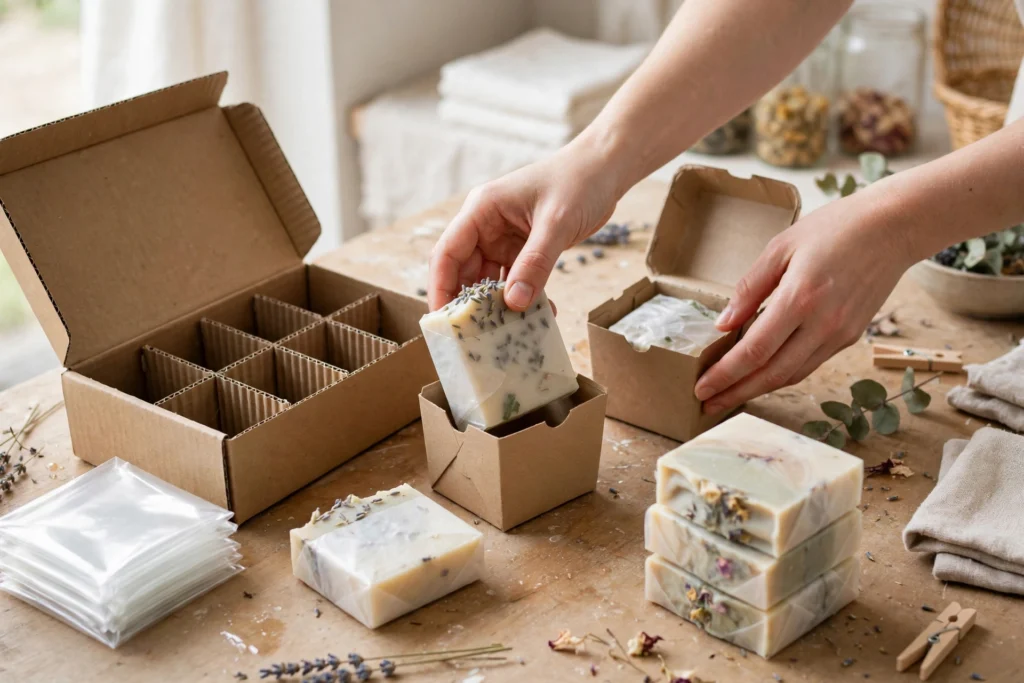
The system has two layers. Layer one is the inner carton. Its job is fit. A snug 18pt carton stops a standard bar from striking anything. It keeps the corners square. It also gives the wrap a clean surface to sit against. Heavy, oil-rich bars need more. They step up to 24pt. A soft bar in a thin carton dents at the corners under its own weight. Over a wrap, a band adds a second skin. One of the soap sleeves in the range holds the label flat and slows scent drift.
Multi-bar orders need more than wrapping. The bars must stay apart. Cardboard dividers and fitted inserts split the inner space into cells. Each bar gets one cell. So nothing knocks. And no two scents share a wall. Gift sets take the idea furthest. lid and tray soap boxes hold each bar in its own compartment, under a lid. The set then arrives looking arranged, not rescued.
Layer two is the outer mailer. Its job is strength. Choose a corrugated mailer that matches the load closely. Leave roughly half an inch of working room around the packed cartons. Do not leave inches of spare space. Advice about 2 to 3 inches of cushioning was written for glass. Soap is dense and small. A dense parcel floating in loose fill lands harder, not softer. Crinkle paper has the same limit. It looks pretty on top. But it settles under weight. So use it as dressing, never as structure. Then run the shake test. Seal the mailer. Shake it hard. Listen. Silence passes. A rattle means a void. And a void is where corners go to die. Purpose-built corrugated mailer boxes are sized for this job. They come in E-flute and B-flute grades that stack without bowing.
| Order | Inner Layer | Outer Layer | What It Stops |
|---|---|---|---|
| Single bar | Wrap plus a snug 18pt tuck end carton | Padded mailer or a mini E-flute mailer | Corner dents in sorting, scent held in |
| 2 to 4 bars, mixed scents | Each bar wrapped, each in its own carton | Right-sized 32 ECT corrugated mailer | Scents stay apart, no void to settle |
| 6 bars or a gift set | Lid and tray set with dividers | B-flute corrugated shipping box | Every bar locked in its own cell |
A Worked Example: Three Bars, Two Scents
Take a common Etsy order. It has three cured bars, at 4.5 ounces each. Two are lavender. One is peppermint. The bars alone weigh 13.5 ounces. Each bar gets a glassine wrap first. Then each gets its own 18pt carton, at roughly half an ounce. The peppermint carton sits in its own corner, behind a divider. So the strongest scent is also the most isolated one. The 32 ECT mailer adds about 3.5 ounces. Sealed and weighed, the parcel lands just under 19 ounces. That is over the under-one-pound tiers. So it prices by weight, or by cubic rate. The small, dense box is exactly the shape cubic pricing rewards. Nothing rattles. Nothing trades scent. And not one ounce of postage bought air.
Seasonal Rules for Heat, Humidity and Cold Snaps
Summer attacks soft bars first. Recipes rich in shea or cocoa butter soften in hot vans and depots. Temperatures climb toward body temperature. A softened bar in a loose carton slumps out of shape. It does this before it melts outright. The snug inner carton is the defense. It holds the shape while the bar cannot. Timing helps just as much. Parcels posted Monday to Wednesday keep moving. A parcel posted Friday can sit in a hot building until Monday. So summer orders ship early in the week.
Humidity works the other way. In a Southern summer, a bar pulls moisture from damp air. It beads with glycerin dew. A rain-soaked parcel can also push damp through an uncoated outer box. An aqueous-coated inner carton sheds that damp instead of drinking it. So the printed surface and the label stay dry. Winter is gentler on soap than on the schedule. Cold hardens bars rather than harming them. So the winter job is simple: keep parcels dry and moving. Melt and pour bars are the exception in every season. They warp in serious heat, on routes through states like Arizona and Texas. They earn a film barrier, and the fastest service the order can carry.
Postage Reality: Weight Tiers Decide the Box
Soap is heavy for its size. So postage turns packaging choices into money. Under one pound, USPS Ground Advantage prices a parcel in tiers. The tiers sit at 4, 8, 12, and just under 16 ounces. Every ounce of packaging counts toward the tier. A mailer one size too big can push a two-bar order over a tier line. Then the seller pays first-class money for air. So weigh the finished, sealed parcel. Never weigh the bars alone.
Multi-bar orders flip the logic. Cubic pricing rewards dense, compact parcels. Ground Advantage Cubic rates a small, heavy box by size, not weight. Sellers buy those rates through platforms such as Pirate Ship. For heavier orders, a flat rate box can beat both. The soap makes the parcel heavy. But inside a flat rate box, that weight costs nothing extra. The rule under all three is the same. The smallest strong mailer that passes the shake test is also the cheapest one to post.
Label the Bar Before It Travels
A wrapped bar still needs its legal label. In the USA, the rules split by what the soap claims. A true soap is made mainly from oils and an alkali. It makes no claims beyond cleansing. The CPSC regulates it. Its label needs three things: the product identity, the net weight in ounces and grams, and the name and address of the maker or distributor. But claims change the law. The moment a bar promises to moisturize, beautify, or treat the skin, it becomes a cosmetic. The FDA then regulates it. The label also grows. An ingredient declaration in INCI terms joins the weight and identity. The FDA soap questions page settles borderline cases in plain language. So print the label for the claim, not for the recipe. Then the parcel is legal in every state it crosses.
Four Checks Before You Seal the Mailer
Together, these four checks finish the job of how to ship handmade soap well.
- The shake check. Sealed mailer, shaken hard: silence passes, any rattle means repacking.
- The corner check. Press each corner of the mailer with a thumb. A corner that gives has a void behind it, and voids collect damage.
- The scent check. Leave one mixed order sealed for an hour, then open it and smell each bar. If the peppermint has moved into the lavender, the barriers failed while the return shipping was still free.
- The weight check. Weigh the sealed parcel and buy the tier it actually falls in, with the right label for the claims on the bars inside.
Four checks, under two minutes. Every failure they catch is one a customer never sees.
Crushed boxes and mixed scents look like shipping problems. But both are decided at the packing table. A barrier on every bar. A snug inner carton. Dividers where bars share a ride. A corrugated mailer sized to the load. That is the whole system. Every layer in it works best when it is cut to the bar it carries. That holds from the inner carton to the wider soap packaging the finished sets travel in. So test the setup first. Run a sample of your own best seller through the mail. It is the cheapest proof, before the holiday orders land.