
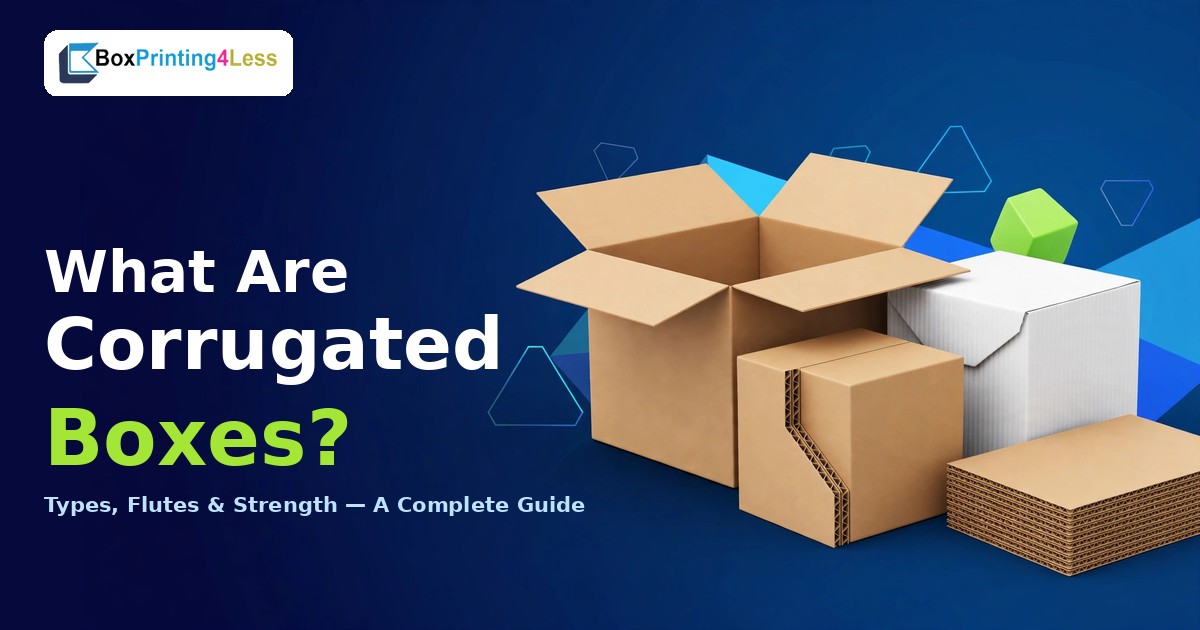
Take any shipping box and look at its cut edge. You will not see one plain sheet. You will see a wavy layer fixed between two flat sheets. That wave, in fact, is the real secret of the box.
So, what are corrugated boxes? They are shipping boxes made of corrugated board. The board joins flat paper sheets, called liners, to a wavy paper layer, called the flute. The wave makes the board strong. Still, the box stays very light. That is why almost every product travels in one — a small candle sent across town, or a heavy motor sent across the country.
In this guide, you will learn the basics in simple words. What is the board made of? How is it different from plain cardboard? What types can you buy? And how do you pick the right one for your product?
What Is a Corrugated Box Made Of?
The board has only two parts.
The liners. These are the flat sheets on the outside and inside. The outer liner is mostly kraft paper. Fresh wood fibre makes it strong, and it also prints well. The inner liner is often test paper. It has more recycled paper in it, so it costs less.
The flute. This is the wavy layer in the middle. Hot rollers press the paper into waves. Then a starch glue joins it to the liners.
Glued to just one liner, a flute sheet works as a soft wrap. Add a second liner, and you get a proper box board. More flute and liner layers then make the board thick and strong. That is how the wall types below are made.
One more good point. Most corrugated board comes from recycled paper. In fact, recyclers collect old boxes and turn them into new paper again. So a used box can go back into paper recycling. It does not have to end up in a landfill.
Corrugated Box or Cardboard Box — What Is the Difference?
Most people call every brown box a “cardboard box.” But in packaging, the two are not the same. Picking the wrong one can cost you money.
Cardboard — its real name is paperboard, is one solid sheet. A cereal box is made of it, and so is a shoe box. It folds neatly and prints beautifully. But it has no cushion, and it cannot carry a stack of weight.
A corrugated box is different, though. It has that wavy layer in the middle. The waves work like small arches. They take the knocks, stop the box from crushing, and carry the weight of the boxes placed on top.
So the rule is simple. If the box will travel by courier or sit on a pallet, use corrugated. If it will sit on a shop shelf inside a shipping box, paperboard is fine. In short, many brands use both: a printed cardboard box for the product, kept safe inside a corrugated box for the journey.
Types of Corrugated Boxes by Wall
First, we sort boxes by how many wavy layers the board has. More layers mean a thicker, stronger box. They also mean a higher price. So pick the wall that fits your load. Not weaker. Not stronger than you need.
Single Face Board (2-Ply)
One wavy sheet glued to one liner. That makes two layers — 2-ply, for short. The sheet bends easily, so nobody uses it for closed boxes. Instead, it works as a soft wrap that protects a product inside a stronger box.
Single Wall Boxes (3-Ply)
One wavy layer between two liners. Three layers in total — also called 3-ply. This is the normal shipping box. In fact, most online orders travel in it.
In the common 32 ECT grade, it can carry up to about 65 lbs. That covers most small goods, such as books, clothes, candles and makeup.
For example, small sizes do a big part of this work. Our 4x4x4 corrugated boxes are a good size for small parts, jewellery and samples. And a flat pack of 10x8x4 shipping boxes is a handy size for folded clothes, books and boxed shop products. If your products are light, single wall is mostly all you need.
Double Wall Boxes (5-Ply)
Two wavy layers and three liners. Five layers, also called 5-ply. The second wall makes the box much stronger. It stacks better, and it is harder to puncture.
So this is the right step up for heavy or breakable goods. Think glass jars, electronics, home appliances and big multi-item orders. A 48 ECT double wall box can carry up to about 80 lbs. It can also stack several boxes high on a pallet.
Our double wall corrugated boxes are made in your exact size. So your product gets a snug, strong box — not a big stock box stuffed with filler. If your single wall boxes ever came back with a crushed corner, this is the wall you were missing.
Triple Wall Boxes (7-Ply)
Three wavy layers and four liners. Seven layers. The board is more than half an inch thick. This is the strongest type of corrugated box.
It is made for industrial loads, motors, compressors, pumps, metal parts and machine parts. The grades go from 67 ECT to 112 ECT. They carry from about 240 lbs up to 300 lbs.
The easy way to see triple wall corrugated boxes is this: they do the job of a wooden crate, but they weigh far less. They ship flat. One person can fold one in minutes. And at the end, you can recycle the board. Most sellers will never need this type. If your load is under 80 lbs, you do not need it either. But for heavy freight, it saves the cost and the wait of building wooden crates.
Types of Corrugated Boxes by Style
The wall decides the strength, while the style decides the shape and the job. These are the styles you will meet most often.
Regular slotted carton (RSC). This is the standard shipping box. One sheet folds into a box. Four flaps on top and four at the bottom meet in the middle, and you tape them shut. Most corrugated boxes sold anywhere are this style. Thus, it is simple, strong and low cost in any size.
Mailer boxes. These are die-cut boxes that fold and lock. They need no tape, and they use a thinner flute, so they look neat and print well. Online stores use them to make a delivery feel like a gift. Our corrugated boxes for ecommerce are made in this style. They are cut to the right size, so you stop paying postage for empty space. Also, you can print them inside and out.
Die-cut packaging boxes. These boxes are cut to the exact shape of a product. They can have a built-in holder inside. A corrugated packaging box like this keeps the product still. It shows the product nicely when the lid opens. And you need no loose filler, either.
Cube boxes. All sides are equal. Cubes are easy to stack and store, and postage is easy to work out, too. A 6x6x6 corrugated cube shipping box is a popular pick for mugs, candles, jars and small appliances that need padding on all sides.
Bin boxes. Not every box is for posting. Bin boxes stand open at the top, with a low front. They sit on shelves in warehouses and workshops, holding parts and stock where staff can see them and pick them fast. Our corrugated bin boxes ship flat and fold together with no tape. They turn a messy shelf into neat, labelled storage.
Flute Types, Made Simple
Each flute has its own letter. The letter tells you how tall the wave is. Big waves give more cushion, whereas small waves give a smoother print.
• A flute — the tallest wave, about 4.8 mm. Best cushioning. Good for fragile goods.
• C flute — about 4 mm. The most common flute in shipping boxes. A good mix of cushion, strength and print.
• B flute — about 3 mm, with more waves packed in. Hard to crush flat. Used for trays, dividers and bin boxes.
• E flute — about 1.5 mm. Thin and smooth. Used for printed mailer and retail boxes.
• F flute — less than 1 mm. The finest wave. Used for small, premium printed boxes.
Double wall boxes often mix two flutes. The common mix is BC flute — B for crush strength, C for cushion. Of course, you do not need to learn the letters by heart. Just tell your supplier what you ship and how far it travels. Picking the flute is their job.
How Strong Is a Box? ECT and Burst in Simple Words
You will see two numbers on box details. Yet buyers often mix them up. You will find both numbers printed in the round stamp on the bottom flap of a box.
ECT (Edge Crush Test). This tells you how much weight the edge of the board can carry before it crushes. The number uses pounds per inch. In other words, ECT tells you how well boxes will stack on a pallet. 32 ECT is the standard single wall grade, for loads up to about 65 lbs. About 44 to 48 ECT is double wall. Triple wall starts at 67 ECT.
Burst strength (Mullen test). This tells you how much pressure the face of the board can take before it bursts. You will see it written as 200# or 275#. It is about punctures and rough handling rather than stacking.
So here is the simple rule. If your boxes are stacked, read the ECT number. If your boxes are thrown around in sorting hubs, burst also matters. A good supplier will ask about your load and your route before giving you a grade.
How to Choose the Right Corrugated Box
Just ask yourself four questions, and the right box will become clear.
1. How heavy is it, when packed?
Under 20 lbs — normal single wall is fine for most goods. From 20 to 65 lbs — single wall can still work, but check the grade. If the item is fragile, step up a grade instead. From 65 to 80 lbs and above — go double wall. For industrial weight, finally, choose triple wall.
2. How fragile is it?
For instance, glass, ceramics and electronics break from knocks, not from weight. They need a cushioning flute and a snug fit. On rough routes, therefore, the second wall pays for itself the first time a parcel is dropped.
3. How far will it travel?
A local courier run is gentle. In contrast, cross-country freight is not. It changes hands many times. It stacks in trucks and warehouses. The longer the journey, the more stacking strength you need.
4. Does the size fit the product?
A box that is too big costs you three times. You pay for filler. You pay extra postage, because couriers charge for the space, not just the weight. As a result, the product slides inside and can break. A box cut to your product’s size quietly saves money on every order.
That is why made-to-size boxes help small sellers. At BoxPrinting4Less.com, every box in this guide is made to order. There is no minimum order. Design help is free, and shipping is free across the USA, too. A small seller can order ten right-sized boxes just as easily as a big seller orders ten thousand.
Quick Questions
What are corrugated boxes?
Boxes made from corrugated board, one or more wavy paper layers (flutes) glued between flat paper sheets (liners). The wave gives the board its strength, cushion and stacking power.
How many types of corrugated boxes are there?
By wall, there are four: single face (2-ply), single wall (3-ply), double wall (5-ply) and triple wall (7-ply). By style, the common ones are slotted cartons, mailer boxes, die-cut packaging boxes, cube boxes and bin boxes.
Which corrugated box is the strongest?
Triple wall. It has three wavy layers and four liners, carries up to about 300 lbs, and replaces wooden crates.
What does ECT mean on a box?
ECT means Edge Crush Test. In short, it shows how much weight the board’s edge can carry before it crushes, in pounds per inch. It tells you how well the boxes will stack. 32 ECT is the standard single wall grade.
Is a corrugated box the same as a cardboard box?
No. Cardboard (paperboard) is one solid sheet, like a cereal box. A corrugated box, in contrast, has the wavy middle layer. That wave is what makes it strong enough for shipping.
Final Word
In the end, a corrugated box is a simple idea: a wave of paper, glued between two flat sheets. But the types made from it cover almost everything, from a tiny candle to a 300 lb motor.
Pick the wall for your weight. Choose the style for your job. Then match the size to your product. Do that, and the box stops being a gamble. It becomes part of your product’s safety.
Still not sure which type you need? Send us your product’s size and weight. We will suggest the honest grade for the job, even if that means telling you the cheaper wall is enough.