


The bar is the same. The world it has to survive in is not.
A handmade soap sold at a Saturday farmers market lives outdoors for six hours, gets picked up forty times, and is bought mostly by nose. The same bar, sent to a boutique across town, may sit under bright lights for three months, read by strangers who will never meet its maker, and judged entirely by its box. Packaging that is perfect for one of these worlds is quietly wrong for the other, and most soap makers only find that out after a faded, dusty, unsold batch teaches them.
That is why how to package handmade soap for craft fairs is really two questions wearing one coat. This guide walks through the four places where market packaging and retail packaging pull in opposite directions: scent against hygiene, weather against lighting, light labels against legal ones, and a folding table against a shop counter. At the end sits a side-by-side table you can plan your next batch from.
The Core Tension: A Bar That Must Be Smelled and Must Stay Clean
Every packaging choice on this page grows out of one tug of war. A handmade bar sells through its scent and its surface: the swirl, the botanicals on top, the smell that makes a shopper stop mid-aisle. Cover it completely and you protect it, but you also mute the two things that sell it. Leave it open and it sells beautifully for a day, then collects dust, fingerprints and the smells of every neighbouring bar.
Markets reward the open end of that rope. Retail rewards the sealed end. Neither is wrong; they are answers to different rooms. The mistake is using one answer in both rooms.
At the Farmers Market: The Scent Is the Salesperson
Picture the stall honestly. A shopper lifts your bar, turns it once, and brings it to her nose. That three-second ritual closes more market sales than any label ever printed. If the bar is sealed inside plastic or a closed carton, the ritual fails, and she puts it down and drifts to the stall where she can actually smell something.
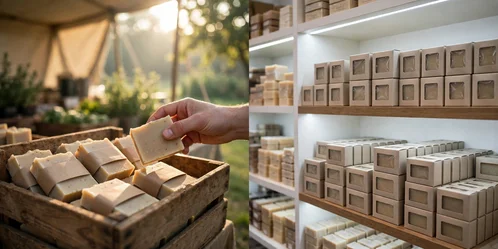
Most soap packaging ideas for farmers market stalls start from that ritual, and they all keep the bar reachable. So market packaging keeps the bar reachable. An open-ended cigar band (the slim sleeve that wraps the middle of the bar) leaves both ends bare for scent and touch while still carrying your name. An open-cutout window does the same job with a frame around it: the bar shows through a die-cut opening with no film in the way, which is exactly what open-cutout window soap boxes are built for. The shopper sees the swirl, smells the bar, and reads the band, in that order.
Weather Is Your Second Customer
A tent is not a shop. Sunlight falls across your table all morning, the air carries humidity, and natural bars answer back: glycerin draws moisture from the air and beads on the surface (the sweating soap makers call glycerin dew), and plant-based colours fade faster under direct sun. Market packaging has to breathe a little and shade a lot. Uncoated kraft is the market workhorse for a reason: it lets the bar breathe, hides the day handling marks, and its matte brown face does not mind the sun the way a glossy print does. An aqueous-coated kraft box adds a light layer of protection while keeping that breathable, rustic character.
Set up matters too, and it matters at 6 a.m. Pre-glued sleeves slide onto a bar in about two seconds, flat-packed boxes fold as you go, and everything rides home in the boot of a car without a fight. At a market, packaging that saves ten minutes of setup is worth real money.
Market Labels Can Stay Light
Face-to-face selling carries its own labelling logic, and in many states a market bar can travel with a slim band: your brand, the scent name, and the net weight, with the maker standing right there to answer everything else. A 1.5 to 2 inch cigar band holds exactly that and nothing it does not need. Keep one habit from the retail world even here, though: the weight goes on every bar, every time, because habits are cheaper than corrections.
In a Retail Store: The Box Does the Selling Alone
Now move the same bar indoors and everything inverts. Nobody is standing beside it to explain the ingredients. It will be handled by shoppers who have no intention of buying it, parked next to strongly scented neighbours, and lit by LEDs for weeks. In that room, an open bar does not look artisanal. It looks dusty, thumbed and faintly borrowed from the bars around it.
So retail packaging closes. A clear film window keeps the swirl visible behind cellophane or PET, sealed against dust and handling. Eco-minded brands ask about the film itself too: plant-based cellulose film exists as the biodegradable cellophane window option, compostable rather than plastic, and it is worth asking your printer what window films are on the table before you settle the design. A full tuck-end carton goes further and presents a clean, printed face on every side. If your bars go to shops, custom printed soap boxes with full panels are the format retailers recognise on sight, because they stack, face forward and stay clean.
Light Behaves Differently Indoors
The market problem was sun; the shop problem is glare. Glossy surfaces bounce LED light straight into a shopper eyes, and a label that cannot be read at arm length might as well be blank. Matte lamination is the retail answer: it kills the reflection, so the ingredients, the barcode and the brand all stay readable from any angle, and it shrugs off the fingerprints of a hundred casual pick-ups better than gloss ever will. Retail stock follows from that: a coated 18pt to 24pt cardstock takes the print, the matte finish and the months of handling in one package.
A quick thickness translation, because points confuse everyone. Cardstock weight is measured in points, and the ladder is simple: 14pt to 16pt is the light end, flexible and friendly to bands and sleeves that wrap a bar closely; 18pt to 24pt cardstock is the sturdy end, the stock that stands upright on a shelf for months without bowing or denting at the corners. Market packs live happily at the light end. Retail boxes should not.
Retail Labels Are Not Optional
A boutique or grocery buyer will not shelve a bar that arrives under-labelled, no matter how good the soap is. The retail panel needs room for the full legal set: a UPC barcode, the complete ingredients list in proper INCI order, the net weight in both ounces and grams, and the maker name and address. That is a lot of small print, and it has to sit flat, legible and unhurried on a back panel. Full tuck-end cartons give it a home. So does a wide retail sleeve of about 3.5 inches when a band format is preferred, which is why custom soap sleeves come in wide retail cuts as well as slim market bands. Rules vary by state and by retailer, so check yours before the print run, not after.
True Soap or Cosmetic? The Claim Decides the Rulebook
Before any of that print goes on, one question decides which rulebook your label answers to, and it is the most useful thing a US seller can learn about how to label handmade soap for sale. If your bar is sold only to clean (a true soap, made largely from the classic alkali-and-oils reaction, with no cosmetic promises on the label), it sits under the Consumer Product Safety Commission, and the essentials are the product identity, the net weight, and the name and address of the maker or distributor. The moment the label promises more (moisturising, softening, beautifying), the bar becomes a cosmetic in the eyes of the FDA, and the full cosmetic rulebook follows, including the complete INCI ingredients list in descending order. Claims that cross into treatment territory (eczema relief, anti-acne, healing) push it further still, toward drug rules nobody wants. Practical translation: your marketing words choose your label workload, so choose them before the packaging is printed, and check the current FDA and CPSC guidance for your exact case.
And one wholesale detail inside the barcode line: boutiques and grocery chains generally expect a GS1-registered UPC, bought from GS1 itself, because codes from cheap resellers often fail or collide in their till systems. Do handmade soaps need barcodes for retail? In serious retail, yes, and registered ones.
The Counter Is a Shelf You Ship
Store owners are busy in a way market shoppers never see. A product that arrives needing to be unpacked, sorted and arranged one bar at a time starts its retail life as a small annoyance. A countertop display box avoids the whole conversation: it ships full, the lid folds back, and the box itself becomes the shelf, holding 12 or 24 bars in neat rows with dividers keeping scents apart. Shipper and display in one piece of board is what countertop soap display boxes exist for, and it is the single easiest way to look professional to a first retail buyer.
Standard Handmade Soap Box Dimensions
Most handmade bars come out of a small family of common moulds, so a few sizes cover most of the bars ever poured. Use this chart as a starting point for standard handmade soap box dimensions, then do the one thing the chart cannot do for you: measure your own bar.
| Bar weight | Common cured bar size | Box inner size to order |
|---|---|---|
| 4 oz | 3.5 x 2.25 x 1 in | 3.6 x 2.35 x 1.1 in |
| 4.5 oz | 3.5 x 2.5 x 1.1 in | 3.6 x 2.6 x 1.2 in |
| 5 oz | 3.75 x 2.5 x 1.25 in | 3.85 x 2.6 x 1.35 in |
The small allowance in the second column is breathing room, not slack: enough for the bar to slide in without scuffing, never enough for it to rattle. Round, oval and topped bars break every row of this table, which is why the tape measure outranks the chart, always.
The Side-by-Side: Market Stall vs. Retail Shelf
| Packaging factor | Farmers market / craft fair | Retail store / boutique |
|---|---|---|
| Best box style | Open-cutout window box or cigar band sleeve | Full tuck-end box or clear film window box |
| Main buyer trigger | Smelling the scent and touching the texture | Reading ingredients, brand story and a clean shelf look |
| Labelling space | Minimal: logo, scent name, net weight | Full retail set: UPC barcode, INCI list, warnings |
| Display format | Wooden crates or flat-packed table stacks | Countertop display boxes with dividers |
| Recommended stock | Uncoated brown kraft, rustic and breathable | 18pt to 24pt coated cardstock with matte lamination |
Read the table as two shopping trips, not two opinions. The market trip is sensory and fast; the retail trip is visual, slow and unsupervised. Package for the trip your bar is actually taking.
What Both Worlds Agree On
Underneath the argument, the fundamentals never change. Fit the packaging to the finished bar, measured after curing, not to the weight on the scale. The cure runs 4 to 6 weeks, and across it the bar loses water and physically shrinks, so a box ordered against a fresh-cut bar arrives to a smaller soap and a sloppy fit. The same water dance explains how to stop handmade soap from sweating: cure fully, let the bar breathe in market packs, and the glycerin dew mostly minds its manners. ⭐ Test the pack with your own soap for a week before any large run, because oils, humidity and handling all vote. Keep one brand face across both worlds (same logo, same colour story), so a shopper who met you at a market recognises your bar instantly on a shelf. And be honest about what a pack can do: a sleeve is not a shipping solution, a window is not a seal unless the film is there, and no box rescues a bar priced against its packaging.
Many established makers quietly run two packs for one bar: a slim, open market pack for the stall season, and a sealed, fully labelled retail pack for shops. It sounds like double work. It is actually the cheapest version of the lesson, because each pack is only asked to win in one room.
What Each Format Costs You, in Order
Budgets deserve the same honesty as labels. The cost ladder runs like this: a plain cigar band is the cheapest respectable pack a bar can wear, sleeves sit one step up, window cartons cost more because of the die-cut and the film, and a full retail carton with display packaging sits at the top. On every format, the per-piece cost falls as the run grows, which is arithmetic, not a sales trick. What a new maker should not do is buy a retail-grade pack for a market stall, or the reverse: match the spend to the room, the same as the style. Small batches are a legitimate place to start, and a pack that can be reordered identically beats a bargain that changes every time.
Start With the Room, Not the Box
If you sell in both places, do not ask which packaging is best. Ask which room the next batch is walking into, and dress it for that room. The stall wants scent, breath and speed. The shelf wants a seal, a full label and a box that sells while you are somewhere else entirely.
When you are ready to match the pack to the room, the full range of soap packaging styles sits in one place, from market bands to retail cartons, all cut to the bar you actually make.